
Opinion
Guidance

Monday morning starts with good intentions.
A project meeting about coordination on a major scheme.
An update from a client asking for increased clarity on programme risk.
A conversation with the finance team about project margins.
By Tuesday afternoon, the week is already starting to feel different.
A model issue that should have been caught earlier appears during coordination.
A drawing package needs to be reissued due to a minor but important error.
Someone on the team is still trying to find the latest version of a file that seems to exist in three different places.
None of this feels dramatic.
But by Thursday evening, the pattern is familiar.
The team is working late to keep the programme on track. Someone is quietly fixing issues that appeared earlier in the week and the leadership team is asking a question that is becoming increasingly common across the industry: Why does delivery still feel harder than it should?
Across the UK, Europe, the US and the Middle East, the built environment industry is operating in a far more demanding climate than it was even five years ago.
Projects are larger.
Margins are tighter.
Procurement is more complex.
Clients expect more certainty and more transparency.
At the same time, design practices are under pressure from every direction: rising costs, programme compression, recruitment challenges, regulatory scrutiny, and the constant expectation to do more with less.
In this environment, the practices that thrive will not simply be the most creative or the most technically capable.
They will be the ones who deliver consistently and efficiently.
Yet there is a quiet reality inside many design organisations.
The biggest threat to delivery performance today isn’t talent and it isn’t technology.
It’s the systems that sit behind the work.
Over the past decade, the architecture and engineering sector has embraced digital tools at an extraordinary pace.
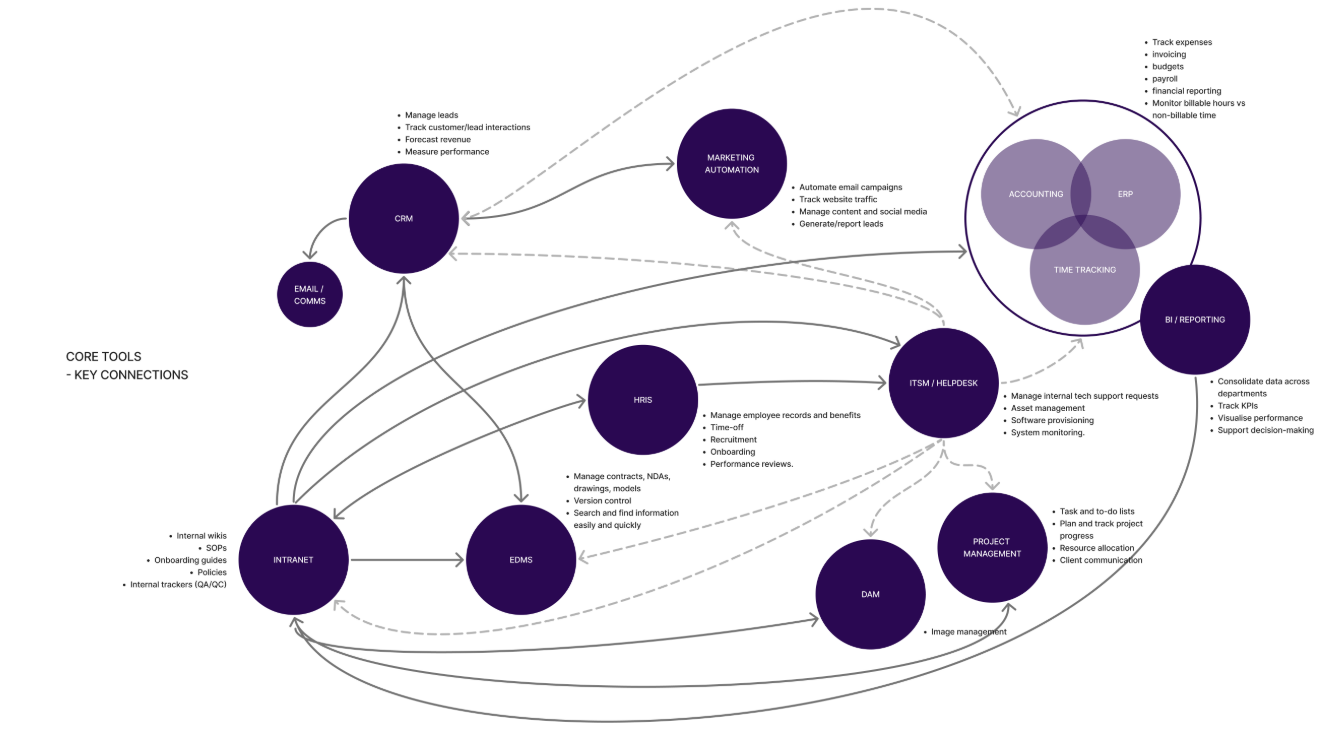
Most practices today operate with a combination of:
Each tool solves a specific problem. Individually, they are powerful. But collectively they often create something far more complicated than anyone intended.
A fragmented delivery system.
It is increasingly common to see information duplicated across platforms, responsibilities blurred between teams, and coordination delayed beyond what it should be. Designers spend time navigating processes rather than progressing design.
None of this is dramatic enough to trigger a crisis.
But it quietly erodes productivity; when that friction exists across dozens of projects, it begins to affect something every practice cares deeply about; delivery certainty and margin.
When delivery pressure increases, the industry’s instinct is often to look for new tools.
A new platform.
A new dashboard.
A new workflow layer.
But technology alone rarely solves operational friction.
In fact, without the right foundations, it often adds complexity.
This is why some practices that invest heavily in digital tools still find themselves battling the same delivery challenges:
The issue isn’t capability.
Most design teams are highly capable.
The issue is that the system connecting people, information and tools hasn’t been intentionally designed.
At Adeptus, we often talk about The 5:30 Principle™.
It’s a deliberately simple idea.
Every improvement made to a design practice’s systems should help teams:
If a change makes delivery more complicated, more bureaucratic, or harder for teams to operate within, then it probably isn’t the right solution.
Because the real goal of digital transformation shouldn’t be to introduce more complexity.
The real goal of digital transformation is to remove work friction, making delivery simpler and more predictable.
When we review how design practices deliver projects, we rarely begin with software.
Instead, we look at the delivery system as a whole.
Where does information originate?
How does it move through the team?
Who owns it at each stage?
Where do errors tend to appear?
Where is time quietly leaking from the process?
When these questions are explored honestly, patterns begin to emerge.
Often, the biggest improvements come from relatively simple changes:
None of these changes is particularly glamorous. But, collectively they create something that is surprisingly rare in the built environment sector; calm, predictable delivery.
The current economic climate makes operational clarity more important than ever.
Across many regions, construction activity is becoming more selective, clients are more cautious, and design teams are expected to demonstrate greater value and accountability.
Practices that can deliver reliably, efficiently and with minimal friction will be in a far stronger position than those relying purely on technical capability.
In other words, the competitive advantage of the next decade may not simply be better design software, or AI for that matter.
It will be better delivery systems.
The encouraging reality is that most practices already have the ingredients they need.
Talented people.
Powerful tools.
Ambitious projects.
What is often missing is a clear structure that connects those elements together.
When that structure exists, the results are noticeable very quickly.
Projects move with more clarity.
Teams spend less time chasing information.
Delivery becomes calmer and more predictable.
With that, leaders are no longer relying on late nights and heroic effort to keep things on track. Because most practice owners and directors don’t lose sleep worrying about design quality. They lose sleep worrying about whether projects will land well, whether teams are under too much pressure, and whether margins are slowly being eroded by inefficiencies no one has time to fix.
That’s the real cost of delivery friction.
Not just in lost hours.
But in stress, uncertainty, and the constant sense that things could be running better than they are.
The opportunity in front of the industry right now is surprisingly simple.
No more software.
No more complexity.
The answer is a stronger delivery system; one intentionally designed for clarity and efficiency, integrating people, processes, and tools so projects run smoothly, and teams operate with less friction.
Because when the way work flows is designed intentionally, something powerful happens.
Projects run more smoothly.
Businesses become more resilient.
Teams regain time to focus on the work they actually care about.
Ultimately helping you deliver excellent work, build a healthy practice, and enable teams to get home on time.
For many practice leaders, the challenge isn’t recognising the problem.
It’s finding the time and perspective to step back and examine how delivery really works across the organisation.
Where is time being lost?
Where are errors entering the system?
Where are teams doing work that shouldn’t be necessary?
These are the questions that underpin the 5:30 Delivery Audit™, a structured review designed to help practices understand how their delivery systems actually operate and identify the greatest opportunities for improvement.
Because improving delivery performance rarely begins with a new tool.
It usually begins with seeing the system clearly for the first time.
And once that clarity exists, meaningful change becomes far easier to achieve.
The challenge I give to you is - start by focusing on your delivery system, schedule a delivery audit or initiate a review to transform how your practice delivers. Years from now, you’ll be glad you said goodbye to a life of stress and uncertainty.